Synthetic users for website testing: how AI personas find what your analytics miss
Synthetic users for website testing are AI personas, built from your customer research, that open your live website in a real browser, try to complete a task and say what confuses, worries or stops them. They show why people drop off, which analytics can't, in about 5 minutes per run instead of the weeks a user study takes.

On this page
- What are synthetic users for website testing?
- What can synthetic users find that analytics can't?
- When should you use synthetic users?
- How does a synthetic user test work?
- How accurate are synthetic users?
- How do synthetic users compare with other methods?
- Where do synthetic users fall short?
- Is testing with synthetic users GDPR-safe?
- FAQ
In short
- Analytics shows where visitors leave. Synthetic users, also called AI personas or digital twins, tell you why.
- Use them before a launch, before an A/B test, during a redesign, on logged-in journeys and in new markets.
- In our own study, they found 80% of a moderated focus group's core findings, with no contradictions, plus 40% more that other real people confirmed.
- They are good at pre-testing, repeat testing and generating hypotheses, and can stand in when there is no time for real users. They never fully replace them: people with business context still decide, and big decisions call for a mix of methods.
What are synthetic users for website testing?
A synthetic user is an AI agent briefed as one of your customer personas. It opens your site in a real browser, clicks, scrolls and reads like a customer would, and thinks out loud along the way. For each session you get the path it took, its quotes, a screenshot of every finding and a ranked list of what to fix.
Three terms get mixed up here:
- Synthetic users, AI personas and digital twins usually mean the same thing in website testing: AI personas built from your customer data that act on your real pages.
- Synthetic monitoring is different. Scripted bots check that a page loads and a checkout works. They tell you the site is up, not whether a person would understand it, trust it and buy.
- AI survey tools simulate interview answers. Synthetic users act on your actual pages, so every piece of feedback is tied to what they saw on screen.
What can synthetic users find that analytics can't?
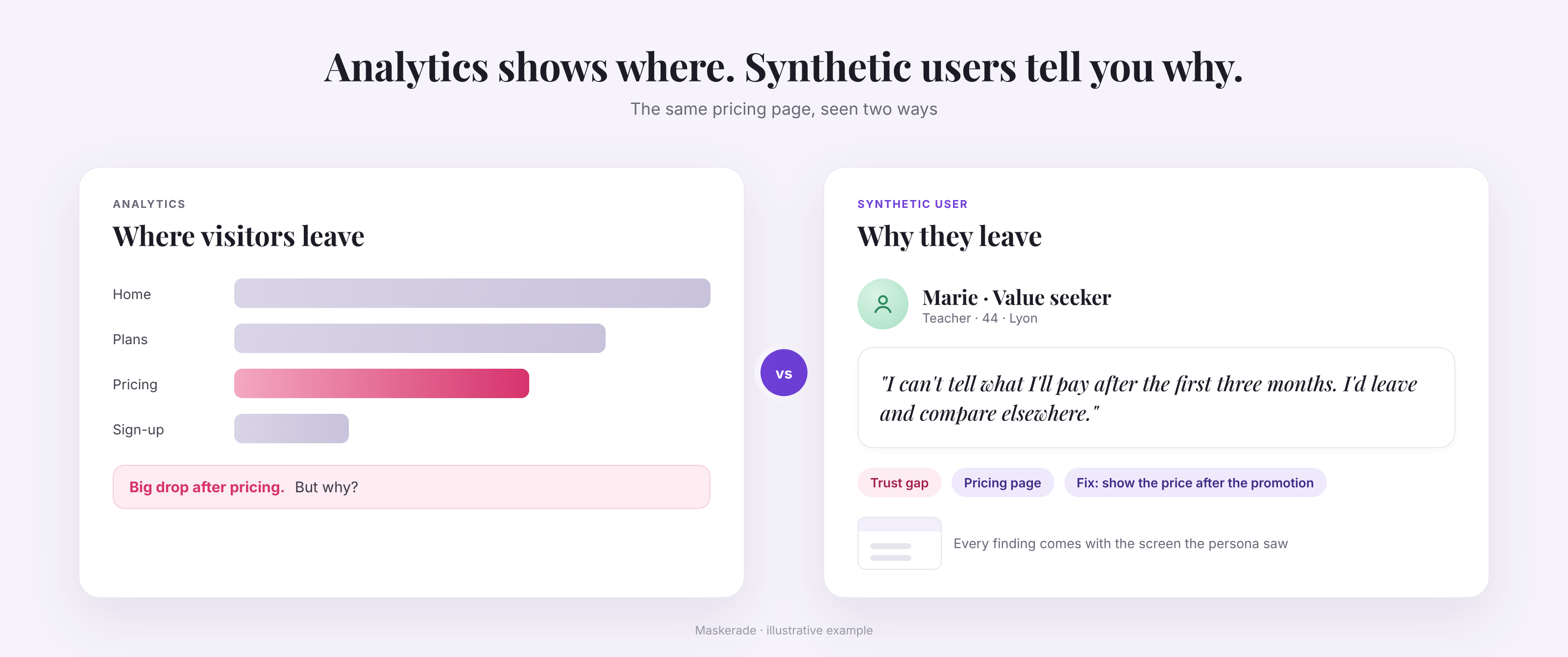
Analytics counts behavior. It tells you that half your visitors leave the pricing page, not that they can't work out the monthly cost after the promotion ends. Synthetic users give you the reason, in the customer's words, with the screen they were looking at.
In customer projects, that has meant:
- Things that are broken, and flows that make no sense. In every customer project so far, personas found something broken, such as missing content on a page, and flows that don't add up, such as a form that asks for information the customer doesn't have.
- Gaps nobody on the team could see. An Italian persona found that MIRON's live chat was still in English. A Kenyan persona hit a language issue on a reading platform that the team hadn't caught, because nobody on it browses the site as a reader in Kenya.
- Friction behind a login. At a top European telco, 35 personas ran 140 sessions through 4 customer portal journeys and surfaced more than 100 issues that page analytics alone couldn't explain.
- Moments that break the flow. On the same reading platform, an audio player that opened in a new window interrupted listening. The team moved it onto the page.
When should you use synthetic users?
Use them wherever you'd want customer feedback but can't get it fast enough, or at all.
| Moment | The question | Example |
|---|---|---|
| Before a launch | Will people understand the new site? | MIRON tested its new multilingual B2B site with 5 buyer personas: a month of research in a day, replacing more than EUR 10,000 of research |
| Before an A/B test | Which ideas are worth testing? | ENGIE reviewed 42 recommendations, shipped 9 right away and sent 20 to A/B testing |
| During a redesign | Did the change fix the problem? | Re-test with the same personas after every change |
| Logged-in journeys | What happens after sign-in? | A top European telco: 140 portal sessions, 100+ issues |
| New markets | Does the site make sense in each country? | A reading platform tested 20 countries with 182 personas |
As MIRON put it: "You don't need a huge research project to start getting value from it."
How does a synthetic user test work?
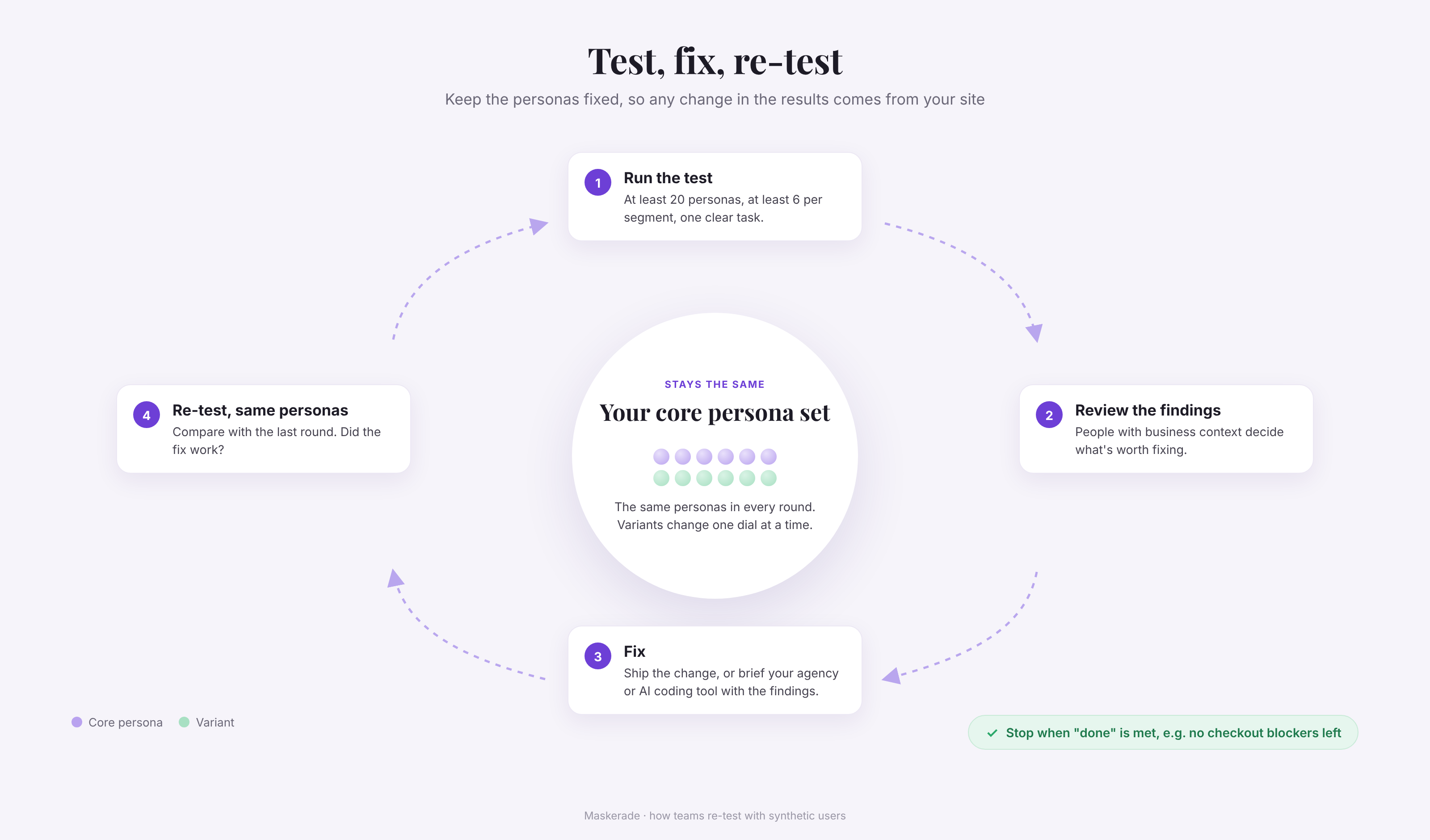
A run takes about 5 minutes, not weeks, and a test follows the same six steps every time:
- Build personas from what you already know. There are three ways in: upload raw data, such as interviews, survey answers or NPS verbatims; use persona descriptions you already have, uploaded or typed in; or, if you have nothing yet, let Maskerade infer personas from your current website.
- Write one clear task. Say what to do, such as "find a plan that fits your household and sign up", not how to do it.
- Do a sample run. Send a few personas through first, so a login wall or a bug doesn't spoil the full run.
- Use at least 20 personas per run. With at least 6 per segment, built as variations of your core personas. Each persona finds its own path, so volume is what covers the journeys.
- Review with people who know the business. Personas know what customers feel, not your regulations or what you tried last year.
- Fix, then re-test with the same personas. Because the personas didn't change, any difference comes from your site.
More best practices for each step can be found in Synthetic users: 13 best practices from real customer projects.
How accurate are synthetic users?
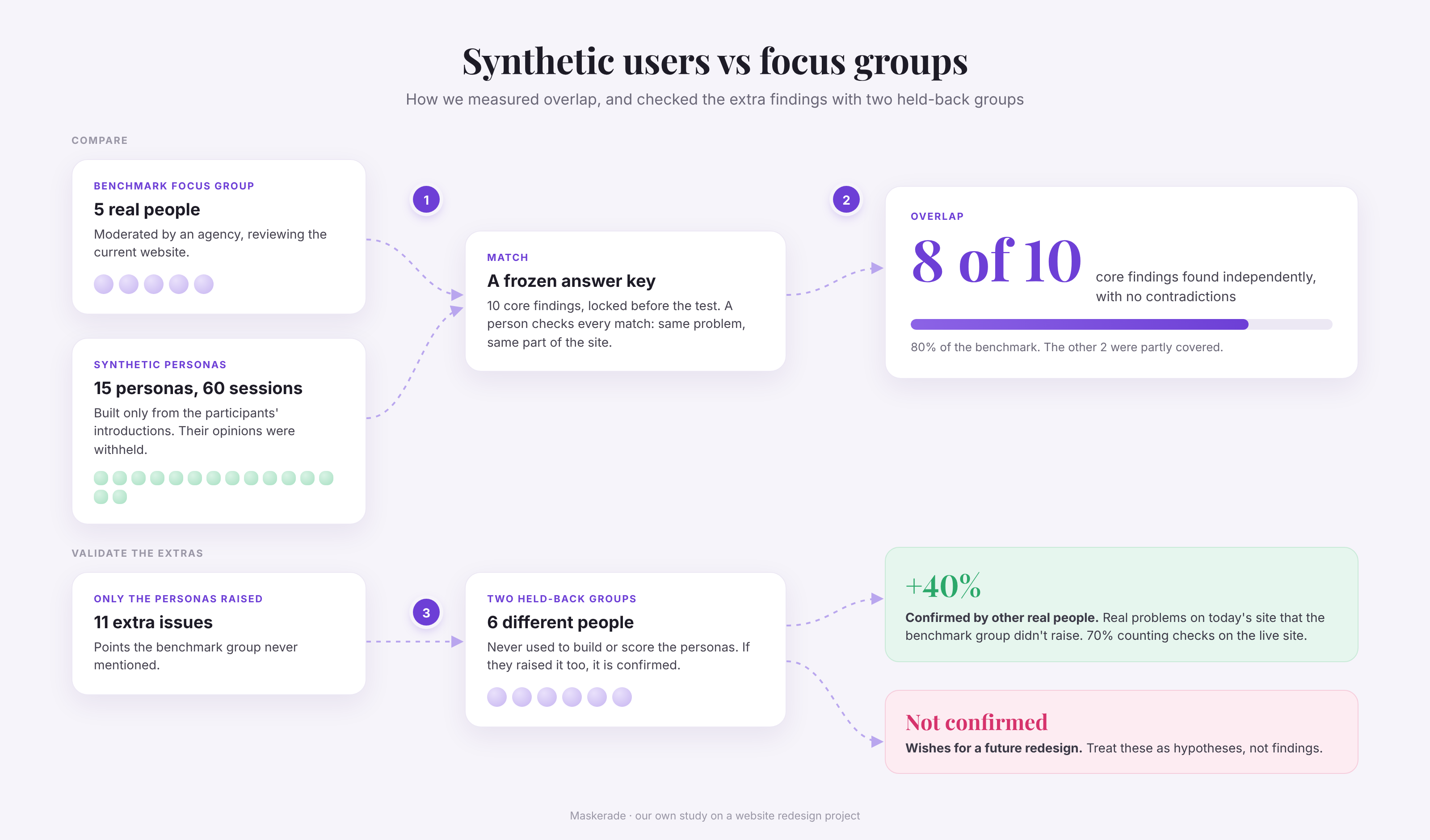
In our own study, synthetic users found 8 of the 10 core findings (80%) of a moderated focus group on the same website, and contradicted none of them. They also found 40% more issues, which two other focus groups confirmed. What didn't hold up were wishes for a future redesign, not problems with the current site. The method is in How accurate are synthetic users? Our focus group study.
Outside research points the same way. Stanford researchers found that AI agents built from in-depth interviews matched people's survey answers 83% as well as the people matched their own answers two weeks later, against 74% for agents built from demographics alone (Park et al., 2024, revised 2026).
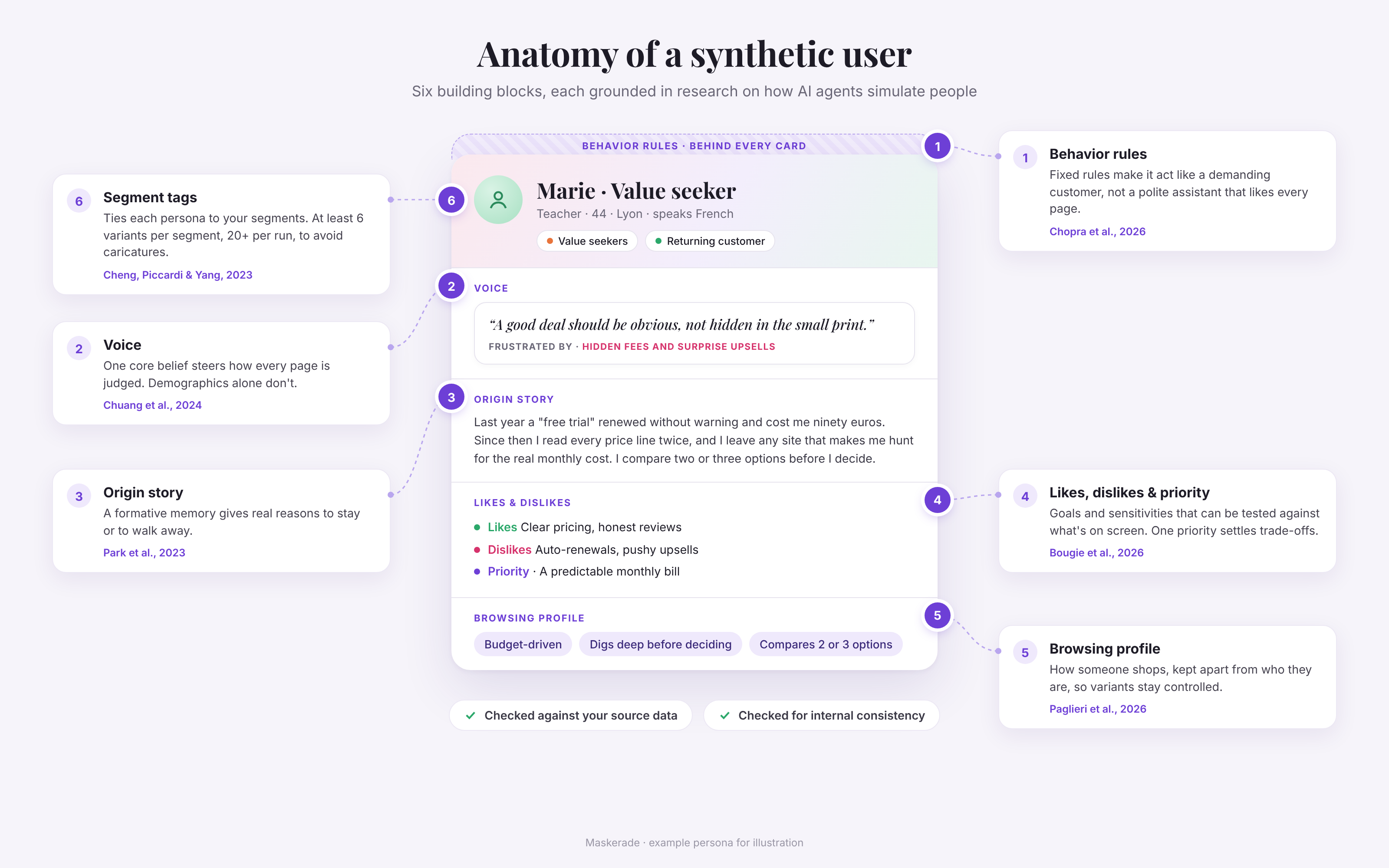
Critics are right that thin personas drift toward average answers, as a 2026 NN/g study shows. That risk shrinks when personas are built from your own research and act on real pages. How we build synthetic users, and the research behind it explains the structure we use.
How do synthetic users compare with other methods?
They fill the gap between what analytics measures and what a user study explains.
| Method | What it tells you | Speed | Main limit |
|---|---|---|---|
| Analytics | Where people drop off | Live | Not why |
| A/B testing | Which version wins | Weeks, needs traffic | Tests one idea at a time |
| Moderated user testing | Why, from real people | Weeks to recruit | 5 to 10 people, costly |
| Synthetic monitoring | Whether the site works | Live | Not whether people understand it |
| Synthetic users | Why, from many personas, on every page | About 5 minutes per run | Weakest on future wishes, needs business context |
The best setup combines them: synthetic users find and filter problems fast, and for big decisions you add focus groups, one-to-one UX research, analytics data and A/B tests.
Where do synthetic users fall short?
- Future wishes. They are strongest on the site as it is today. Treat what they say about features that don't exist yet as hypotheses.
- Business context. They don't know your regulations, technical limits or past experiments. Your team does.
- Thin input. Personas are only as good as the research behind them. If your data leaves a group out, so will they.
- Bot protection. Heavy bot protection can stop a browsing agent, so check access before a big run.
Is testing with synthetic users GDPR-safe?
Personas are built from research about groups of customers, not from tracking individual visitors, and you never need to enter personal data about real people.
Thanks for reading. If I had to sum up this article in one sentence: analytics shows you where visitors leave, and synthetic users show you why.
Elias Veris, co-founderTry it on your own site
Maskerade runs AI personas that browse your website like real customers and tell you where they get stuck. Pick your personas, give them a task on your own site, and read their report about 5 minutes later.
Frequently asked questions
What is a synthetic user?
An AI persona, built from customer data, that browses a real website like a customer and reports what it thinks and where it gets stuck.
Are synthetic users the same as digital twins?
In website testing, mostly yes. Both mean AI personas built from your customer data that act on your real pages.
Can synthetic users replace user testing?
Not fully. They are best for pre-testing, repeat testing and generating hypotheses, and they can stand in when there is no time to talk to real users. For big decisions, a mix of methods works best: focus groups, one-to-one UX research, analytics data, A/B tests and synthetic users.
How many synthetic users do I need?
At least 20 per run, and at least 6 per segment, because each persona finds its own way through the site.
Do I need traffic or existing personas to start?
No. Synthetic users work on a site with no traffic yet, and if you have no research or persona descriptions, Maskerade can infer personas from your current website.
Keep reading
Synthetic users: 13 best practices from real customer projects
How to test your website with synthetic users: 13 best practices from ENGIE, MIRON and other customer projects, plus what our own accuracy study found.
How accurate are synthetic users? Our focus group study
We compared synthetic users with three moderated focus groups on a website redesign. They found 80% of the core findings, plus 40% more that held up.
How we build synthetic users, and the research behind it
How to create synthetic personas that act like real customers: the six building blocks of a Maskerade AI persona, and the research behind each one.