How we build synthetic users, and the research behind it
To create synthetic personas that behave like real customers, give each one six building blocks: behavior rules, a voice, an origin story, likes and dislikes, a browsing profile and segment tags. Fill them from your own customer research, then check each persona against that data and for internal consistency. Every block is backed by published research.

On this page
In short
- One-line personas drift toward average, overly cooperative answers. Structure is what makes a persona behave like a specific person.
- Every Maskerade persona has the same six building blocks, visible in the persona card.
- We designed that structure after reviewing 61 research papers on AI agents, persona simulation and consumer behavior.
- The content of each block comes from your research, not from the AI's imagination.
Why structure matters
Ask a language model to "be a budget-conscious parent" and you get a polite, reasonable, average parent. Real customers are none of those things. They have a bad memory of a past purchase, a pet peeve, a budget, and a habit of leaving a site the moment something feels off.
Research backs this up. Silicon samples built from broad demographics collapse toward the most common answer and lose the variety of real people (Li, Li and Qiu, 2025). Give a model a detailed first-person backstory instead, and its answers start to track real subgroups much more closely (Argyle et al., 2023). The NN/g study on synthetic users made the same point from the other side: thin personas give average answers.
So we spent our time on the structure of a persona before anything else.
The six building blocks of a synthetic user
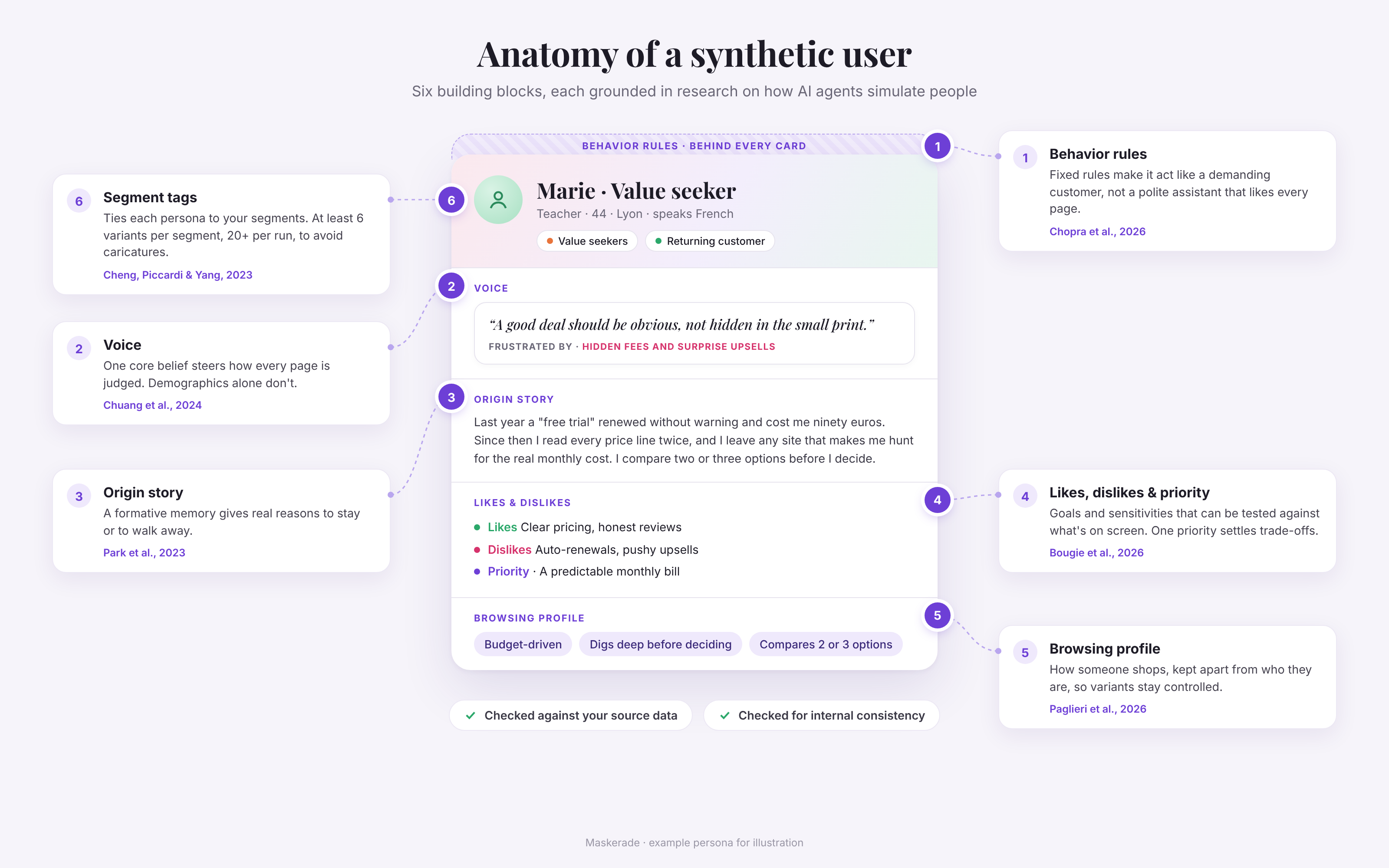
We call this structure the persona anatomy. The visual below shows the six blocks on an example persona card, each linked to the research behind it. The examples in the text come from Amélie, a 31-year-old administrative assistant in Namur, Belgium, who speaks Belgian French and is shopping for a young family.
1. Behavior rules: a customer, not an assistant
Every persona runs under fixed behavior rules that users don't see in the card. They make it act like a demanding customer instead of a helpful assistant: critical but fair, and reacting from its own background rather than reciting it.
Why: AI user simulators are naturally over-cooperative and too similar to each other, so the systems they test look better than they are with real, unpredictable people (Chopra et al., 2026). A persona that likes every page is useless for testing. Rules alone aren't enough, though: telling a simulator it may walk away doesn't teach it who would walk away (Chen, 2026). That is why the reasons to leave live in each persona's own story (block 3).
2. Voice: what this person believes
The voice is a core belief in the persona's own words, plus what frustrates them. Amélie: "Raising a family shouldn't bankrupt you, and retailers who want my hard-earned money must respect my distinct cultural identity." She is frustrated by France-French localization that treats Belgian shoppers as an afterthought.
Why: demographics alone don't reliably make an AI agent think like a group of people. Seeding it with one specific belief does, and that belief carries over to related topics (Chuang et al., 2024). The voice is that belief seed.
3. Origin story: the memory that drives behavior
The origin story is a short backstory with one formative memory. Amélie once lost an hour and fifty euros on a pharmacy site that didn't accept her Belgian postal code. Since then, she leaves any site that treats Belgium as a suburb of Paris.
Why: people act on past experiences, and so do good agents. Agents seeded with short paragraphs about who they are, split into discrete memories, behave in believable, consistent ways (Park et al., 2023). The richer the real material behind them, the better: agents built from in-depth interviews predicted people's answers far better than agents built from demographics (Park et al., 2024). That's why we write origin stories from your interviews and customer verbatims, not from a list of demographics.
4. Likes, dislikes and one priority
Each persona has clear likes, clear dislikes and one priority that wins when they conflict. Amélie likes volume discounts and per-unit pricing, dislikes hidden costs and France-French wording, and her priority is saving on baby essentials without giving up on regional authenticity.
Why: synthetic users judge a page better when their goals, constraints and sensitivities are spelled out and tied to what's on screen, and irrelevant demographic detail is left out (Bougie et al., 2026). A single priority also tells the persona what to do when price and trust pull in different directions, which is exactly where real customers drop off.
5. Browsing profile: how this person shops
The browsing profile captures how this person shops: how price-driven they are, how far they dig before deciding and what catches their attention. Amélie is a budget shopper who explores in depth and compares before she buys.
Why: two people with the same demographics can browse completely differently. Placing personas along explicit dimensions, instead of letting a model improvise them, produces populations that cover far more of the real range of people, including rare combinations (Paglieri et al., 2026). Keeping how someone browses separate from who they are also makes it easy to create controlled variants.
6. Segment tags: tied back to your data
Every persona carries tags for the customer's own segments, such as region, life stage and customer type. Amélie sits in a Walloon young-families segment and a consumer segment.
Why: tags let you compare segments in one run and keep each persona traceable to the research it came from. They also drive volume: we create variations of each segment, at least 6 per segment and at least 20 personas per run, because single-dimension personas turn into caricatures and too few personas only cover a few paths (Cheng, Piccardi and Yang, 2023).
Where the content comes from
The structure is ours. The content is yours. Most customers already have persona descriptions, which are research someone has already summarized, so we start from those. If nobody has summarized it yet, we start from the research you already have: interviews, segmentation studies, NPS verbatims, surveys. For a top European telco, we turned 34 research sources into 35 personas, with each trait traceable to its source. And if you have neither, we infer personas from your website.
Two checks on every persona
We learned this one the hard way. In our early testing, some personas contradicted themselves, and a persona that contradicts itself can't act like one consistent person.
So every persona goes through two checks before it browses a single page:
- Against the source data. We compare the generated persona with the research it came from. Nothing gets in that your data doesn't support.
- For internal consistency. We check that the voice, origin story, likes and browsing profile all describe the same person.
The same two checks run again on every variant we generate automatically, so a library of 30 personas is as clean as the first one.
How we test that it works
Structure only matters if the output holds up. In our own study, synthetic users built this way found 8 of the 10 core findings (80%) of a moderated focus group on the same site, with no contradictions, plus 40% more that two other focus groups confirmed. We explain the full method in How accurate are synthetic users? Our focus group study.
Sources
- Argyle, L. et al. (2023). Out of One, Many: Using Language Models to Simulate Human Samples. Political Analysis.
- Bougie, N. et al. (2026). PerceptUI: LLM Agents as Human-Aligned Synthetic Users for UI/UX Evaluation.
- Paglieri, D. et al. (2026). Persona Generators: Generating Diverse Synthetic Personas for Arbitrary Contexts.
- Chen, L. (2026). Simulated Customers Never Walk Away: Decision Fidelity of LLM User Simulators Measured Against Real Purchase Outcomes. arXiv preprint.
- Cheng, M., Piccardi, T. and Yang, D. (2023). CoMPosT: Characterizing and Evaluating Caricature in LLM Simulations. EMNLP 2023.
- Chopra, H. et al. (2026). Beyond Cooperative Simulators: Generating Realistic User Personas for Robust Evaluation of LLM Agents.
- Chuang, Y. et al. (2024). Beyond Demographics: Aligning Role-playing LLM-based Agents Using Human Belief Networks. Findings of EMNLP 2024.
- Li, D., Li, L. and Qiu, H. S. (2025). ChatGPT is not A Man but Das Man.
- Park, J. S. et al. (2023). Generative Agents: Interactive Simulacra of Human Behavior. UIST 2023.
- Park, J. S. et al. (2024). Generative Agent Simulations of 1,000 People (now titled "LLM Agents Grounded in Self-Reports Enable General-Purpose Simulation of Individuals").
Thanks for reading. If you remember one thing: a synthetic user is only credible when every part of it traces back to real customer research.
Guillaume Derolez, co-founderTry it on your own site
Maskerade runs AI personas that browse your website like real customers and tell you where they get stuck. Build personas from your own research, give them a task on your site, and read their report about 5 minutes later.
Frequently asked questions
What is a synthetic user?
An AI persona, built from customer data, that browses a real website like a customer and reports what it thinks and where it gets stuck.
How is a synthetic user different from a prompt?
A prompt describes a person in a sentence. A synthetic user has fixed behavior rules, beliefs, memories, priorities and a browsing profile, so it behaves like one specific person across a whole session.
Do I need new research to build synthetic users?
No. Most teams start from the persona descriptions they already have. Raw research, such as interviews or surveys, works too and makes personas even more accurate. With neither, we infer personas from your website.
Is this backed by research?
Yes. We designed the structure after reviewing 61 papers on AI agents, persona simulation and consumer behavior. Each building block above cites one or two of them.
Are synthetic personas the same as digital twins?
The terms overlap. Here, a synthetic persona, a synthetic user and a digital twin all mean an AI persona built from your customer data that acts on your real website.
Keep reading
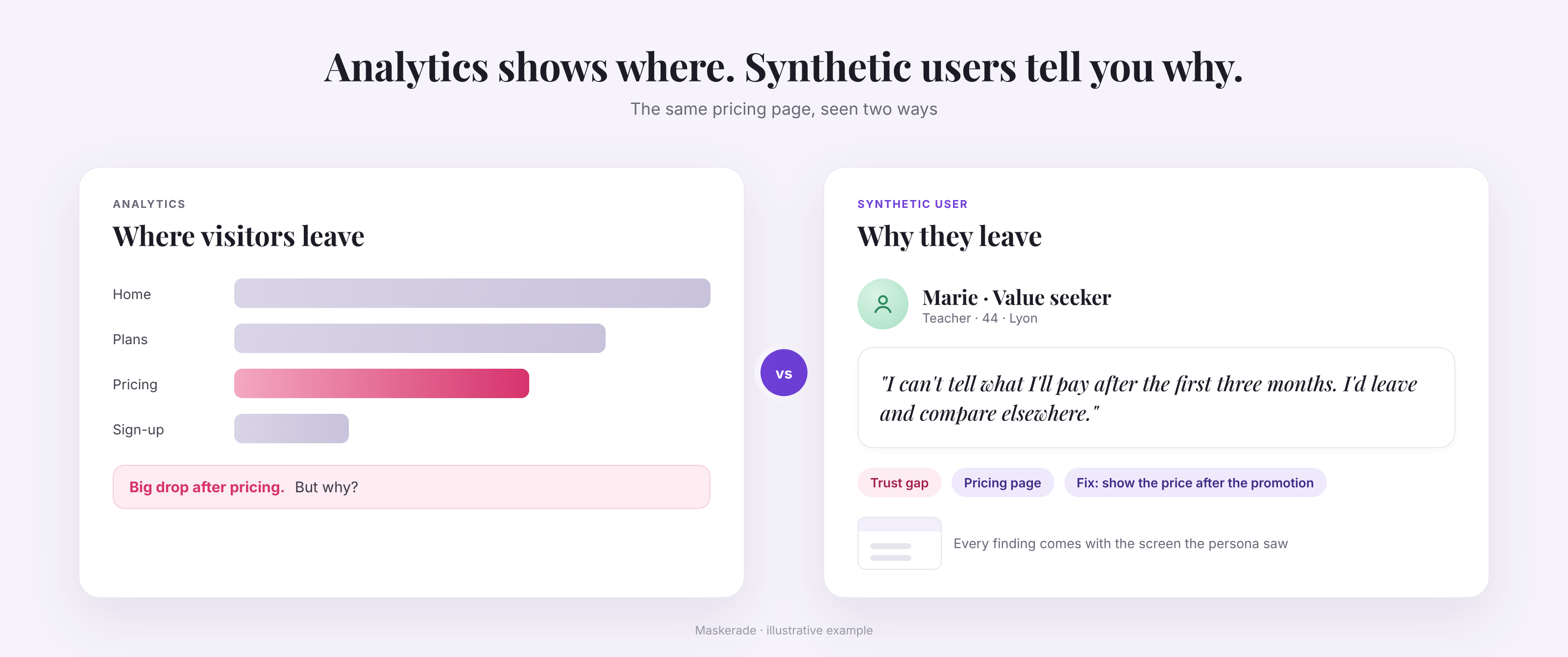
Synthetic users for website testing: how AI personas find what your analytics miss
Synthetic users are AI personas that browse your website like real customers. What they find that analytics miss, when to use them and how accurate they are.
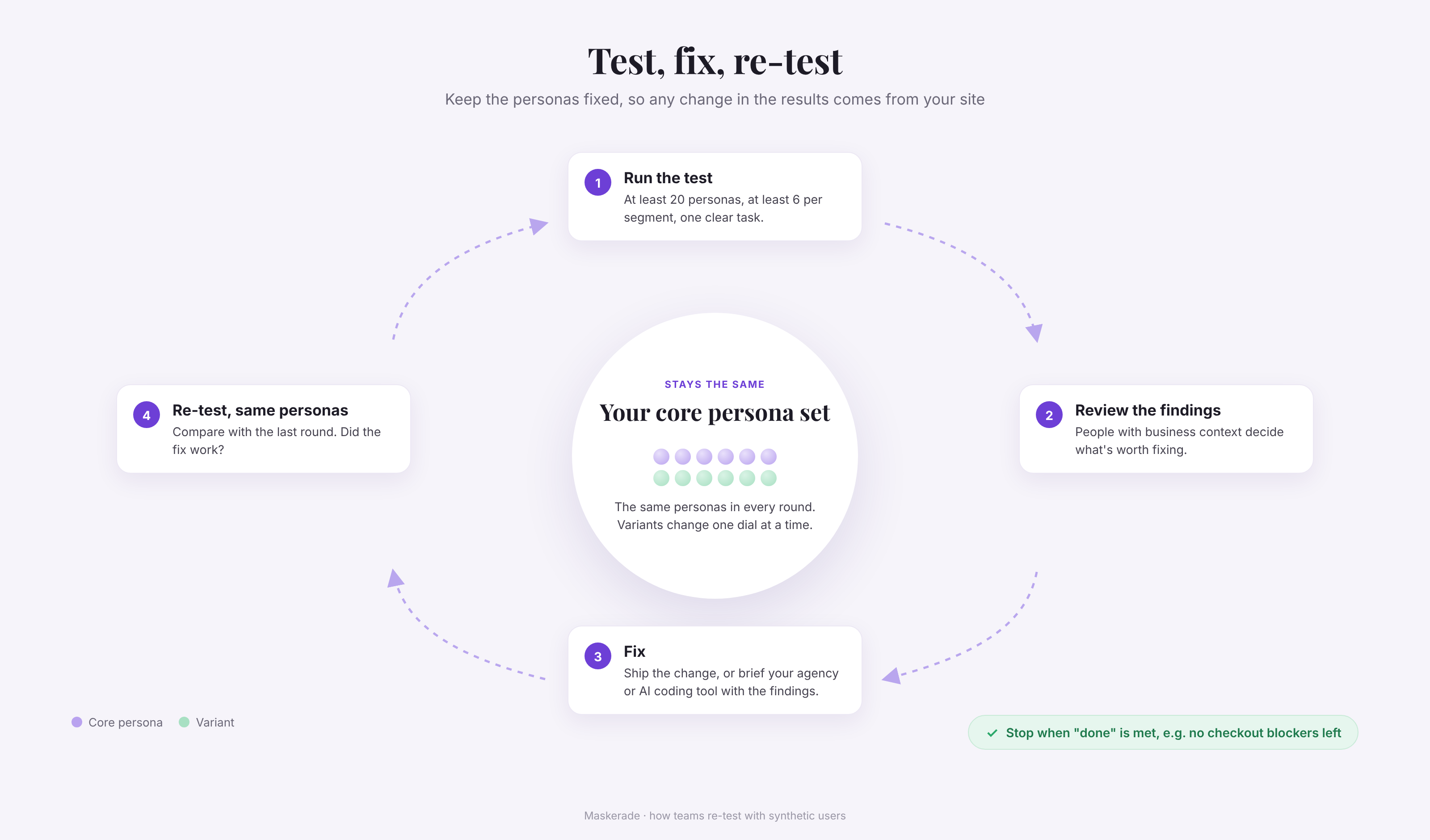
Synthetic users: 13 best practices from real customer projects
How to test your website with synthetic users: 13 best practices from ENGIE, MIRON and other customer projects, plus what our own accuracy study found.
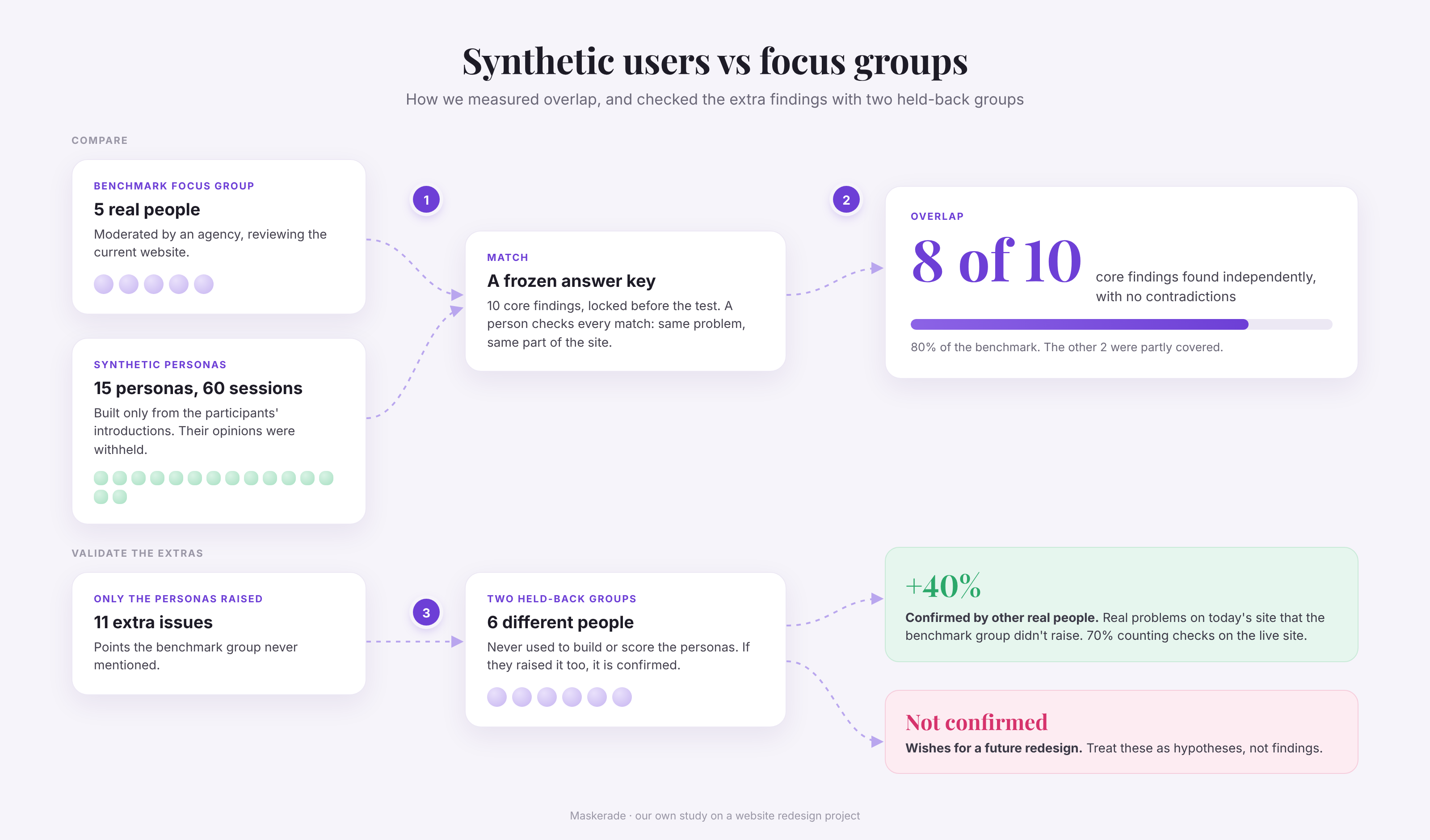
How accurate are synthetic users? Our focus group study
We compared synthetic users with three moderated focus groups on a website redesign. They found 80% of the core findings, plus 40% more that held up.