How to find conversion issues before you A/B test
To find conversion issues before you A/B test, start in your analytics to see where visitors drop off. Then send synthetic users through that exact flow to see why. Each reason they give becomes a hypothesis: fix the obvious problems right away, and A/B test only the ideas worth testing.

On this page
In short
- Analytics tells you where people leave. It can't tell you why.
- Synthetic users, also called AI personas or digital twins of your customers, walk the whole flow and say what stopped them, with the screen they saw.
- Sort what they find into three piles: fix now, A/B test, or drop. The people who know the business make that call.
- ENGIE reviewed 42 recommendations this way. It implemented 9 right away and sent 20 to further research and A/B testing.
- A/B tests still decide what wins. Synthetic users help you spend your tests on the right problems.
Why can't analytics tell you why visitors drop off?
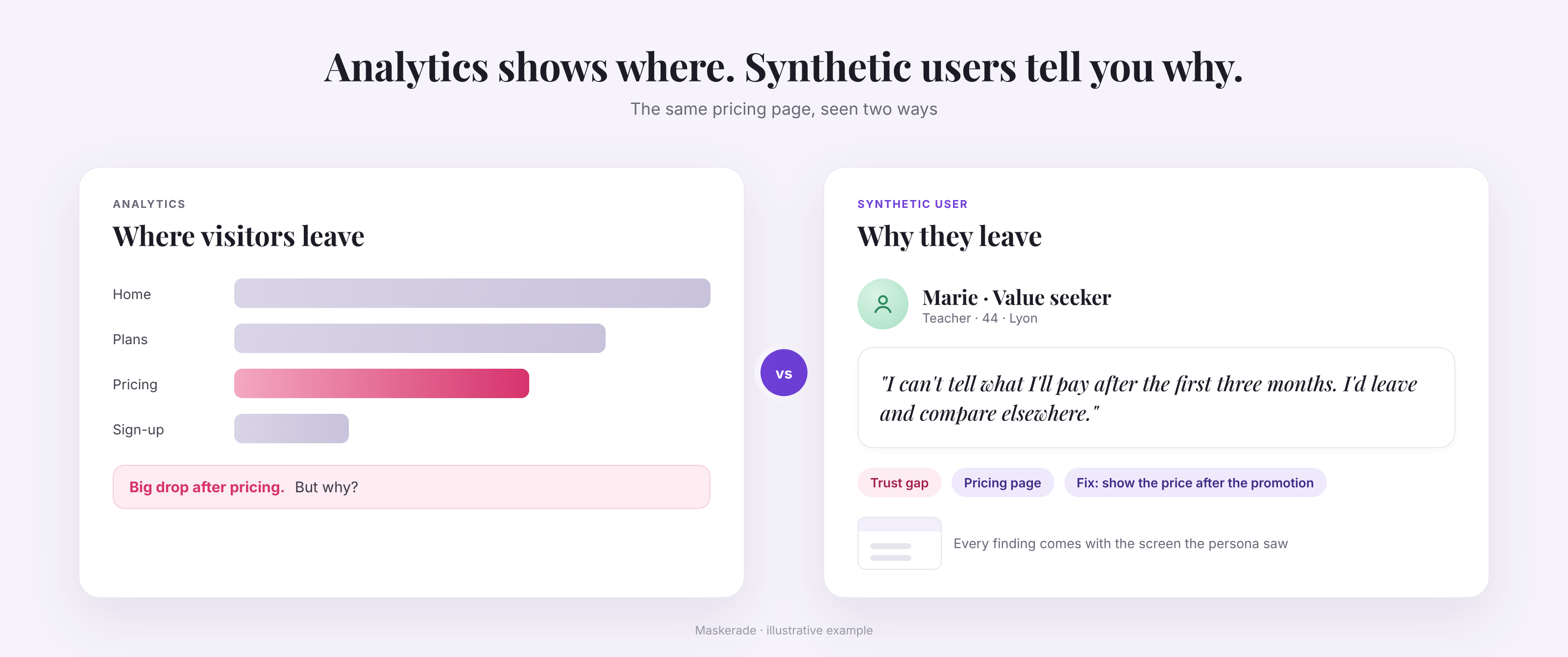
Analytics records what visitors did, not what they were thinking.
A funnel report shows you that many visitors leave your quote form at step 3, but it doesn't show that the price indication on the page is inconsistent with what your prospect saw in the ad they clicked.
Heatmaps and session recordings give you more granular visual information, but you still need to come up with hypotheses to test yourself.
So A/B test ideas often come from opinions in a meeting, and every time you decide to launch a test, you decide to use weeks of traffic to prove you right or wrong. It's a consequential decision.
That is one of the gaps synthetic users fill.
They are not there to replace your analytics. They are there to explain it from the point of view of your customer.
How do you find conversion issues with analytics and synthetic users?
Use analytics to find where, synthetic users to find why, and A/B tests to prove what works. Here are 6 steps to follow to connect the three methods:
- Use analytics to find the drop-off.
Look at your funnel, form or checkout reports and pick the steps where you lose the most people or the most revenue. Start narrow: one journey first. - Pick personas that match the people who leave.
Look at who drops off: new or returning visitors, mobile users, a market, a customer type if you can figure it out.
Create those personas, starting from the persona descriptions you already have, and create at least 6 per segment, so you see patterns rather than one opinion in step 3. - Send them through the whole flow, not just the page.
Launch personas on the critical journey, and make sure they start where real visitors would start: on a search result or a comparison site, from an ad, from the homepage,... so mismatched messages show up.
Give them a broad task, such as "get a quote for your home", and don't mention the problem you suspect, to avoid contaminating the results with your hypotheses. - Read the why at each step. Every finding in Maskerade comes with the page, the journey step and the screen the persona saw, ranked by impact. When several personas stumble at the same step for the same reason, and that is the step where your analytics shows the drop, you have your strongest lead.
- Sort the findings into three piles.
Fix now: clear problems, such as a form that asks for the same thing twice, an inconsistency in price or proposition, or a technical issue.
A/B test: plausible insights with different potential solutions, whose effect on conversion you can't predict clearly.
Drop: ideas that clash with regulation, technical limits or something you already tried. Personas know the customer, not your business, so people who know the business make this call. - Pre-test, then A/B test.
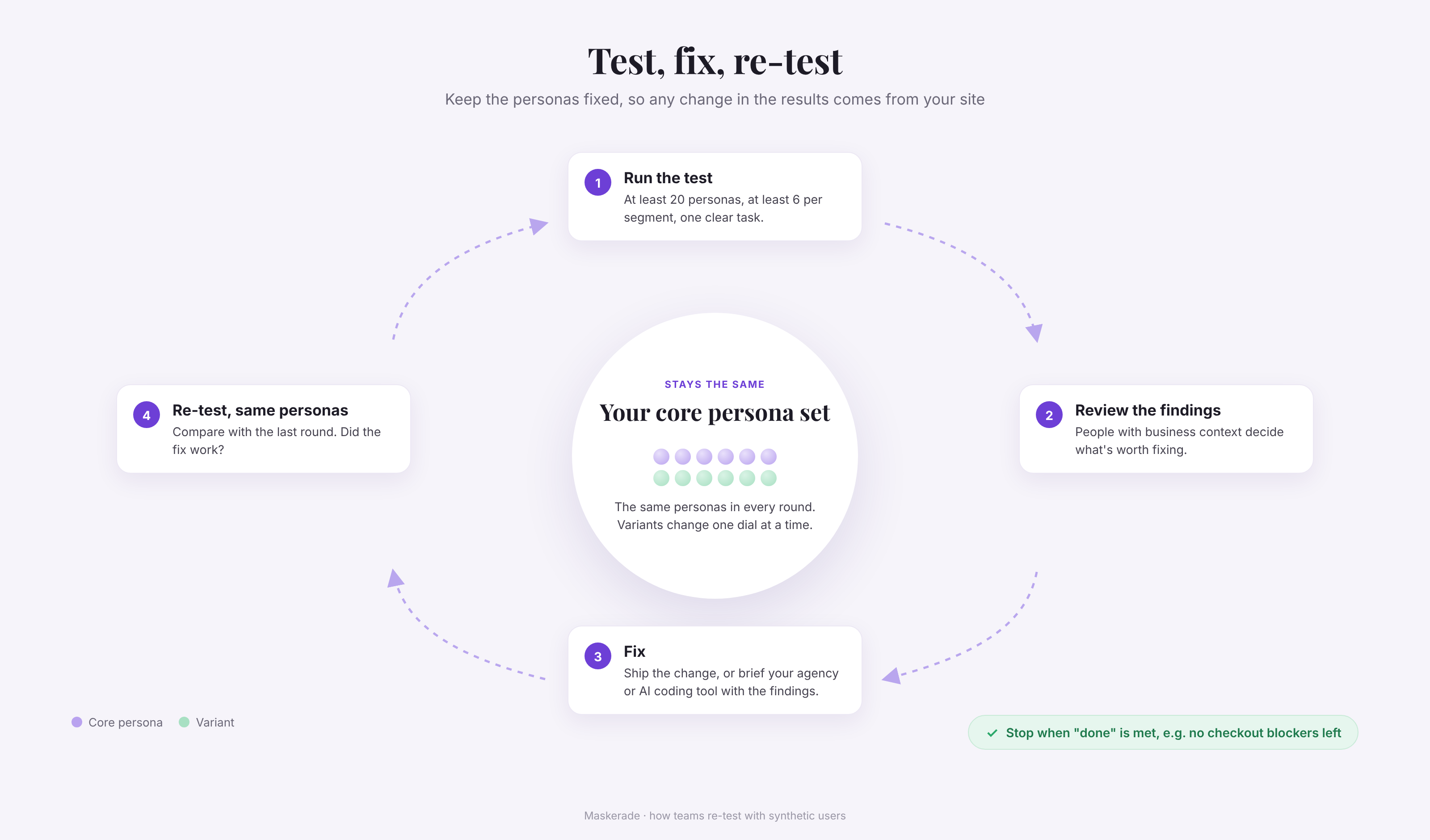
Create your variants, and pre-test them to identify any small QA issues, or to check the change didn't create a new problem further down the flow.
Run the A/B tests to identify the winning variant, and launch it to all traffic.
A run takes about 5 minutes, so you can do steps 3 to 5 in a day, well before the next test slot opens.
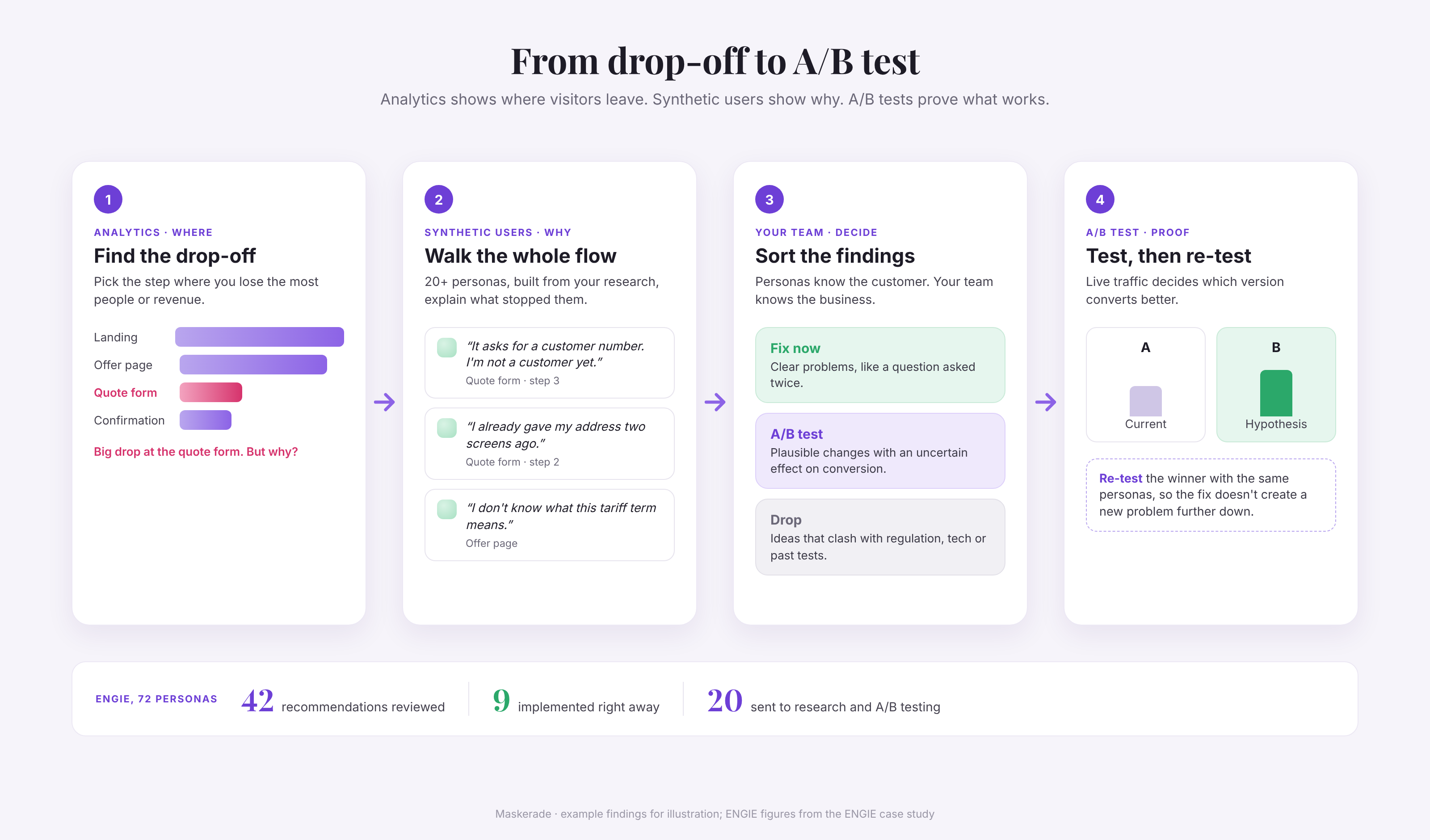
Example: how ENGIE found 9 quick wins and 20 test ideas
ENGIE's online journeys change by region and by what a customer already owns, such as solar panels or an electric car. That makes them hard to test by hand. As Sofie van Eeckhoutte, Chapter Lead Marketing & Digital Performance, puts it: "It takes quite a lot of time for our CRO specialists and our UX specialists to analyze these journeys manually, each individually."
So ENGIE sent 72 synthetic personas, built from its own persona descriptions and customer information, through those journeys. The CRO specialists ran the analysis and pulled out the insights. The UX experts turned them into fixes or A/B tests.
The team reviewed 42 recommendations closely:
- 9 were implemented right away as quick wins.
- 20 were judged plausible and sent to further research and A/B testing.
- The rest were filtered out by people who knew what regulation requires and what is fixed for technical or commercial reasons.
Some of the wins were things the team had stopped seeing. In one flow, customers were asked for the same information twice. "It's something we overlooked ourselves, because the journeys are quite long," Sofie says. The personas also flagged energy jargon that was second nature to ENGIE staff but unclear to customers.
"The biggest advantage is scale," says Sofie. "It's really scaling what we did manually at a small level."
What changed is where its test ideas come from: a steady stream of hypotheses instead of starting from scratch on every journey.
How do you turn a finding into an A/B test hypothesis?
Write down what the personas saw, the change you'll make and the number you expect to move. A finding says what went wrong. A hypothesis says what you'll change and how you'll know it worked. A simple template:
Because {which personas} {did what} at {which step}, we believe {this change} will {move this metric} for {this segment}.
An illustration, based on the jargon ENGIE's personas flagged: "Because several new-prospect personas didn't understand the technical terms on the offer page, we believe plain-language labels will raise quote requests from first-time visitors."
Three checks tell you which hypotheses deserve a test slot first:
- Does the analytics agree? A reason that sits exactly where the funnel drops beats one that sits on a page people rarely see.
- How many personas hit it, and in how many segments? One persona is a hint. Several personas across segments are a pattern.
- What is at stake? Weigh the traffic and revenue at that step against the effort of the change.
What doesn't this workflow do?
It finds the reasons behind a drop-off, but it doesn't tell you how much a fix will lift conversion.
Keep these limits in mind:
- Only live traffic measures conversion. That is what the A/B test is for.
- Personas don't know your business. They don't know what regulation requires, what is fixed for technical reasons or what you already tried. Plan time for people who do to filter the list.
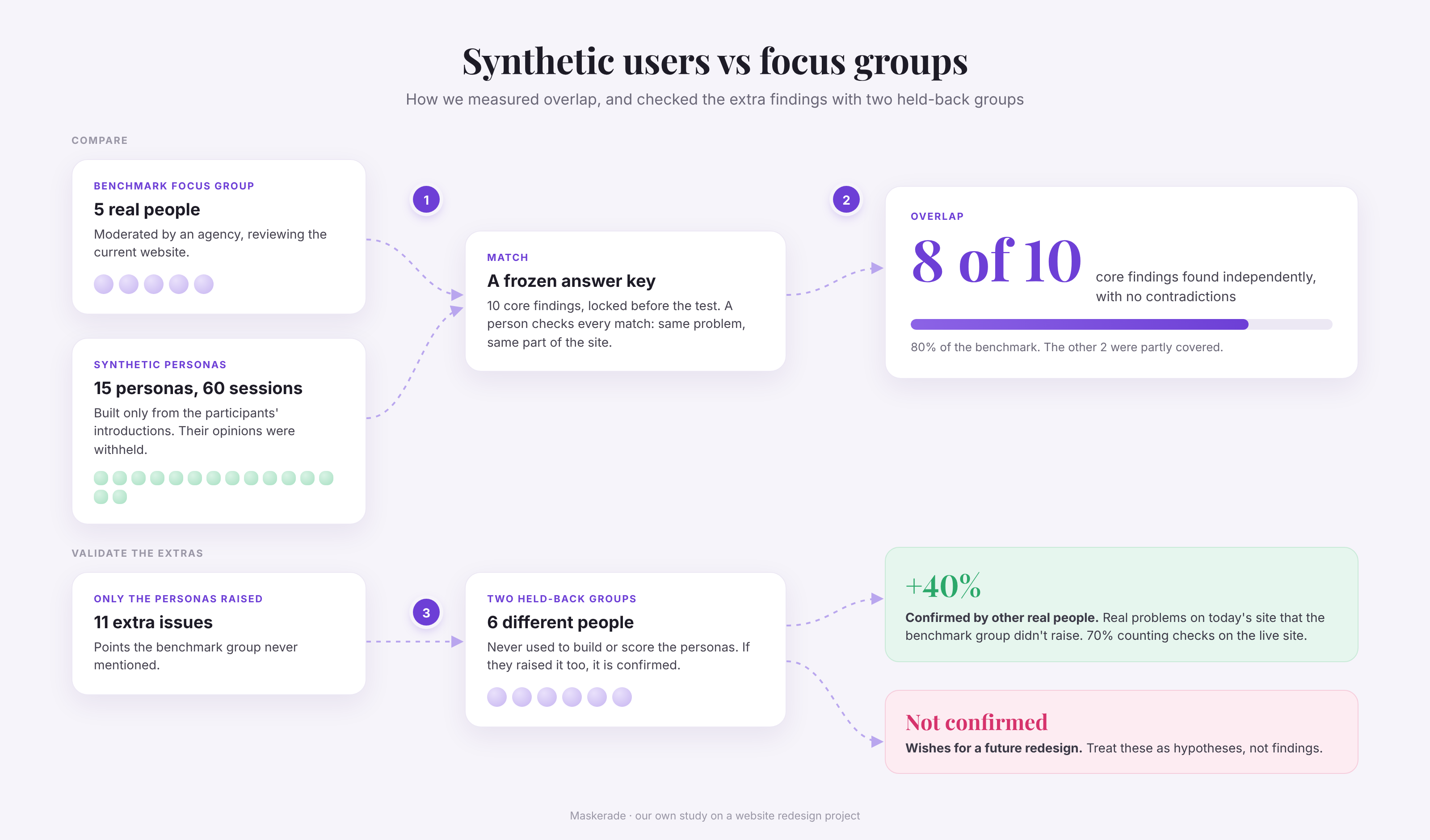
- Findings are hypotheses, not proof. In our own study, synthetic users found about 80% of a moderated focus group's core findings, with no contradictions, plus 40% more that other real people confirmed. That is strong enough to choose what to test, not to skip the test entirely.
For big decisions, a mix of methods works best: focus groups, one-to-one UX research, analytics data, A/B tests and synthetic users.
Thanks for reading. If I had to sum up this article in one sentence: let analytics find the drop-off, let synthetic users explain it, and A/B test only the ideas worth your traffic.
Elias Veris, co-founderFind the why behind your drop-offs
Maskerade runs AI personas that browse your website like real customers and tell you where they get stuck. Point them at the step where your funnel drops, and read their report about 5 minutes later.
Frequently asked questions
What is a good A/B test hypothesis?
One that names the problem you observed, the change you'll make, the metric you expect to move and the segment it applies to. "Let's try a green button" isn't one. "Prospects can't find the price, so showing it above the fold will raise quote requests" is.
Can AI generate A/B test ideas?
Yes. A chatbot can list generic ideas, but it hasn't seen your site. Synthetic users browse your real flow, so each idea comes with the step and the screen it came from.
Do synthetic users replace A/B testing?
No. They're good at pre-testing, repeat testing and generating hypotheses. The A/B test still tells you which version converts better.
How long does it take?
A run takes about 5 minutes. Picking the drop-off and sorting the findings takes longer than the run itself.
Do personas need access to my analytics?
No. You pick the flow from your own analytics, and the personas only need a URL they can open. For logged-in steps, give them realistic test accounts.
Keep reading
Synthetic users for website testing: how AI personas find what your analytics miss
Synthetic users are AI personas that browse your website like real customers. What they find that analytics miss, when to use them and how accurate they are.
Synthetic users: 13 best practices from real customer projects
How to test your website with synthetic users: 13 best practices from ENGIE, MIRON and other customer projects, plus what our own accuracy study found.
How accurate are synthetic users? Our focus group study
We compared synthetic users with three moderated focus groups on a website redesign. They found 80% of the core findings, plus 40% more that held up.